Narrative Writing Matters
Some students may feel like they have nothing to write about or as though they have no experiences they can share that are good enough. It is incredibly important, as teachers, we show our students we all have something to write about and share with others. We need to model different stories to our students and share our own experiences as well. Students need to know they do not have to write about grand events in their life, but they can write about their everyday experiences. They need to know that their stories of going to school or what they did that afternoon is just as important as a story of them going on a big vacation.
Please check out this website to learn more about why narrative writing matters! https://twowritingteachers.org/2015/10/07/why-narrative-writing-matters/
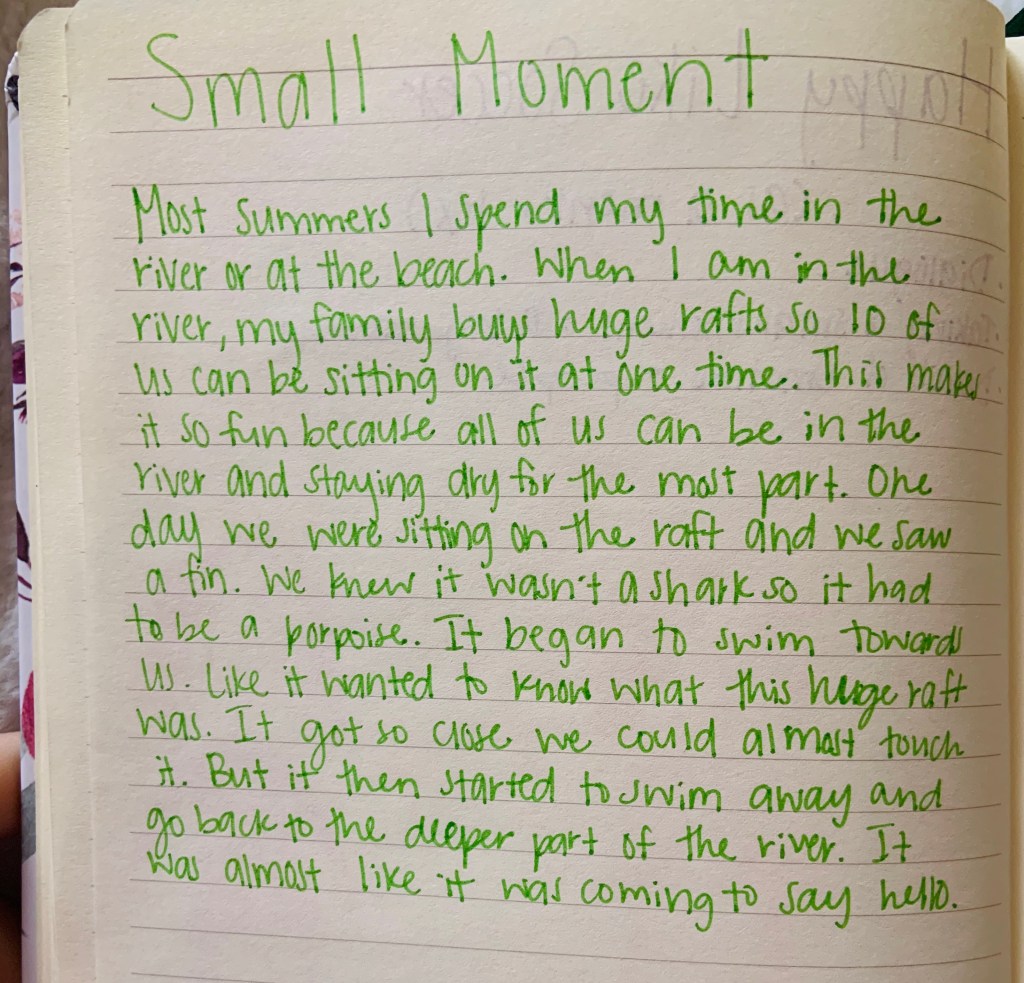
Small Moment Narrative
A Small Moment Narrative is where students can take a small moment from their life and dig deeper to recall certain details that makes this story memorable. Below I have created a draft of my Small Moment Narrative. I will be adding more to the story such as emotions and dialogue throughout my next few drafts. These Small Moment Narratives are a great place for students to start and learn how to elaborate in their writings.
Helping Students to Write Their Stories
There are many strategies that can support students find their voice as writers. These strategies will help the students to begin brainstorming different ideas and topics of their own that they can write about. Mentor texts are also great to incorporate with these strategies. Mentor texts such as Textbook by Amy Krouse Rosenthal, Happy Like Soccer by Maribeth Boelts, and Shortcut by Donald Crews are just a few that can be helpful for a students who is trying to find their own voice as a writer. It is important that when we, as teachers, model these strategies, we use stories that our students can also relate to and not something only we can. If we write about traveling across the country, some or most of our students could probably not relate and would find it harder to find their own voice.
Strategies to help support students
Create heart maps. Heart maps are where students draw a heart and include all the things they love. It can be people, animals, places, and objects. This way when they need to write about something, they have a place to refer back to.
Brainstorming small moments. There are many small moments that happen in our lives. Writing a list of them down first is a great place to start. Then when the students are ready to write about one, they have a whole list to choose from.
Incorporating sensory details (Shubitz, S. 2016.) Have students think about the five senses (touch, taste, sight, sound, and smell) they could include in thier stories. A great mentor text for this would be Happy Like Soccer by Maribeth Boelts. Including these senses will make the reader feel like they are also their.
Create lists of five things you love and five things you dislike. I have done this in a class before and it is very helpful. If a students says, “I have nothing to write about,” the teacher can remind them of these two lists and the student will then have ten things they can pick from to write more in depth about.
Creating a list of important places. This doesn’t have to be anywhere extravagant. It can be places like home, school, dance studio, basketball court, soccer field, grandparent’s house, and so much more. Having this list is also a great place for students to refer back to and they can include details like the emotions or some of the five senses they experience at the special place.
Your Turn Lesson
This Your Turn Lesson is adapted from Drawing and Talking to Find Topics (Dorfman, Cappelli, & Hoyt, 2017, p. 84). This lesson includes the mentor text, Shortcut by Donald Crews. Students draw about an experience they have had that is connected to one like Donald had in Shortcut. They then discuss with a partner, have independent thinking time, and have time for reflection. This Your Turn Lesson can be found HERE.
Dorfman, L. R., Cappelli, R., & Hoyt, L. (2017). Mentor texts: teaching writing through children’s literature, k-6. Portland, ME: Stenhouse Publishers.

 Mrs. Thompson's Blog