Separate Is Never Equal
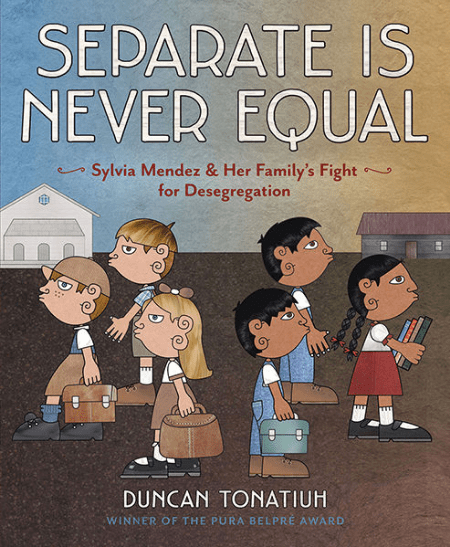
Separate Is Never Equal by Duncan Tonatiuh is about a court case Mendez v. Westminster and focuses the story around Sylvia Mendez’s perspective. The Mendez family had recently moved to Westminster in 1944 and when the three children were enrolling at the closest school, the secretary said they were not allow to attend the school and would need to attend the Mexican school. This made Sylvia’s family very upset and when her father spoke to others in the school system that have more control and they tell him the same, but do not give him a logical explanation of why they have to attend the other school. When Sylvia arrives to the Mexican school which is actually called Hoover Elementary, she recognizes the school is filthy, the halls are smaller, and they are located next to cow pasture. They also had to eat their lunch outside and flies would fly around or be on their food. Her family tried to start a petition but other Mexican families were too afraid to sign it. Later they heard of a lawyer, David Marcus, who has helped with situations like this before. The lawyer agreed to help and four more families decided to join in as well. David Marcus filed the lawsuit in 1945. When the school officials were called to the stand, each one was trying to give excuses as to why Mexican families could not attend the other schools. However, when the truth came out from the first official about how he thought Mexicans were too dirty and they lacked good social behavior, the Mendez family and other Mexican families were taken aback. One education specialist said, “Segregation tends to give an aura of inferiority. In order to have the people of the United States understand one another it is necessary for them to live together, and the public schools is the one mechanism where all the children of all the people go.” This quote stood out to me a lot because of the meaning it carries and how it counteracts all the ideas the more privilege White people had about mixing races in schools. The judge decided to desegregate the schools, but some officials did not like that and had another judge review it as well and he also ruled in the Mendez favor in 1947.
This book was very insightful for me because I have never heard about this case before and it is definitely one that more people should know about. The change and impact one family can make within a community to help benefit all is something more children need to read about. This would also be a great book for children to read since it’s written from the perspective of Sylvia. This case is very important in shaping how schools look like now in the United States compared to 1944. Many times we hear about the Brown v. Board of Education, but this one is justas important and relevant.
This video has interviews from Sylvia and others that are mentioned in Separate Is Never Equal.
Duncan Tonatiuh is the author and illustrator of Separate in Never Equal. He is was born in Mexico City and grew up in San Miguel de Allende, Mexico. I loved how Tonatiuh incorporated the mother saying her quotes in Spanish and then writing it in English next to it. As a reader, it allowed me to feel like I knew her mother better and to connect to the character as well. The artwork in this book was beautiful as well and in an article Tonatiuh says, “That is why my art is very geometric, my characters are always in profile, and their ears look a bit like the number three. My intention is to celebrate that ancient art and keep it alive.” (Counter Storytelling)
In an article by Elizabeth Marshall, she writes about graphic life writing. This refers to a life story through images and text within a picture book or comic. “Graphic life writing, then, arises as a powerful medium for representing diverse realities, for creating a culturally specific curriculum, and for exemplifying how to fight institutionalized racism.” (Counter Storytelling) This relates back to the framework of critical race theory (CRT) which helps analyze the stereotypes the author address about the characters and how the characters overcome these stereotypes.
These are the pictures I chose from Separate Is Never Equal to show where the author includes stereotypes and where the characters overcome it.
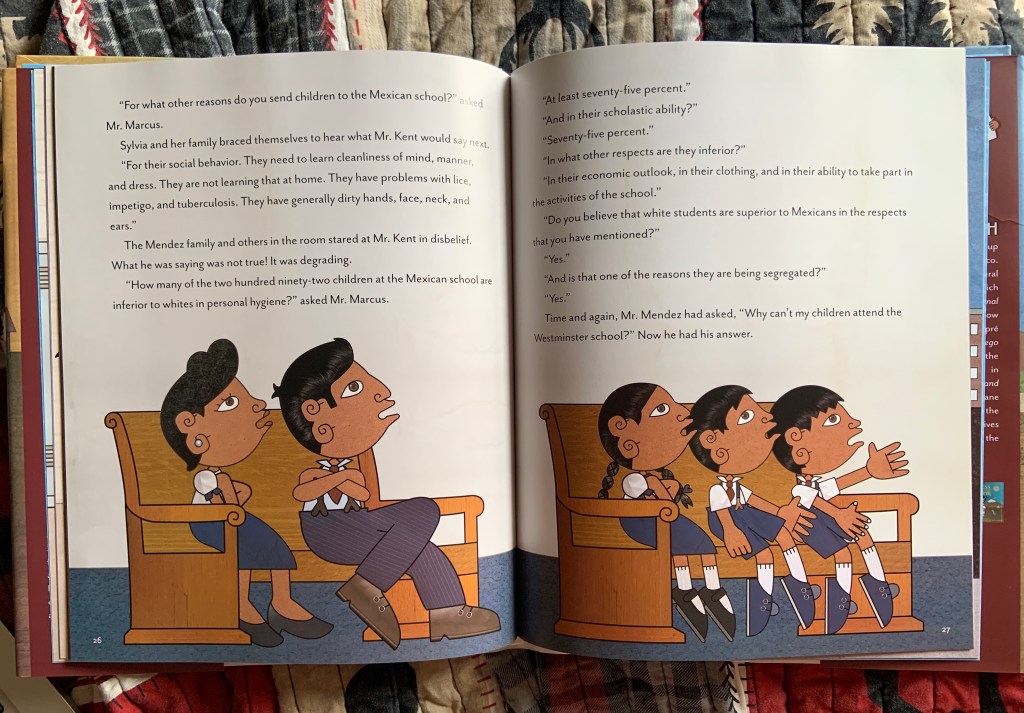
I choose this picture as the stereotype because this is where Mr. Kent, the superintendent of the Garden Grove district, says that Mexicans do not have good social behavior, they are dirty, and believes that white students are superior to Mexicans. The Mendez family is struck by these words and have finally found the true answer of why they could not attend the white school. This view was from a white person who believed that they were than other races and deserved more. Separate Is Never Equal focuses on this topic a lot because that is the reason for this court case.
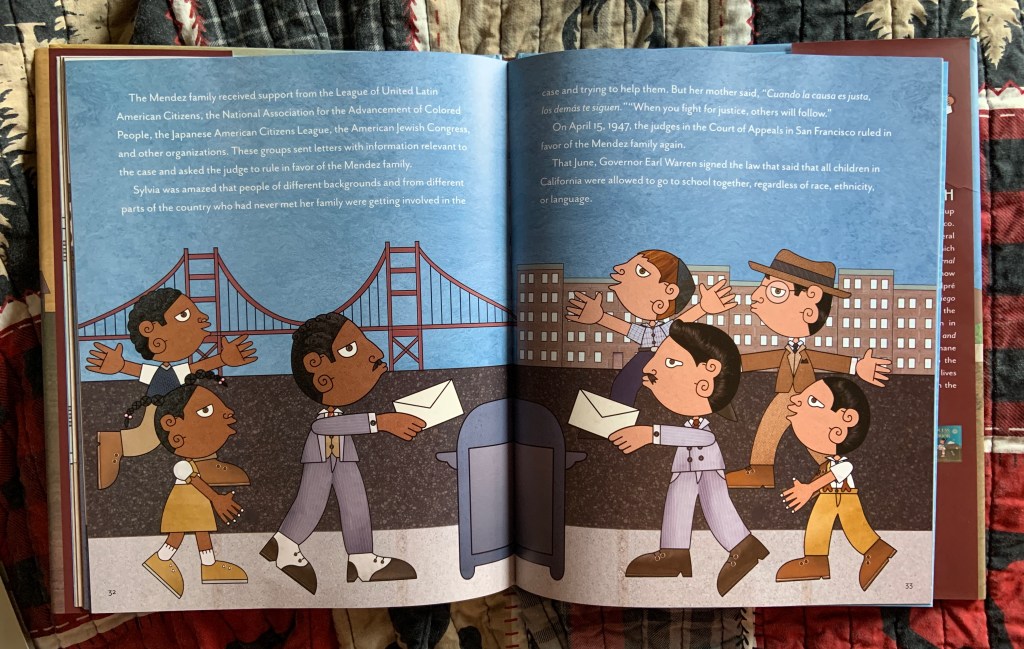
I chose this print as the counter-storytelling because it shows different races and ethnicities coming together to fight for the greater good of the students. When the school board appealed the ruling, different organizations like the League of United Latin American Citizens, the National Association for the Advancement of Colored People, the Japanese American Citizen League, and the American Jewish Congress all supported the Mendez family. This layout demonstrates the power we can have for an issue when we all come together.
Duncan Tonatiuh’s website: http://www.duncantonatiuh.com/
Here are additional videos to go along with Separate Is Never Equal. One is about Sylvia Mendez and the other is an interview with Ruby Bridges.
Can I Touch Your Hair?
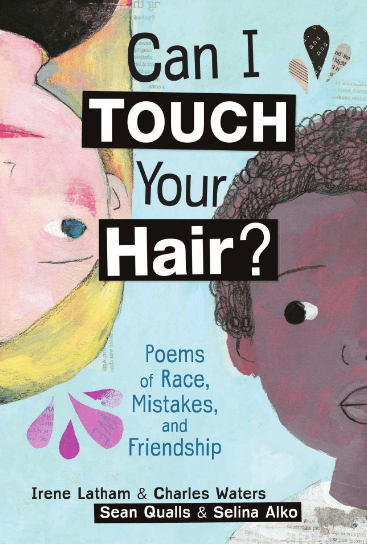
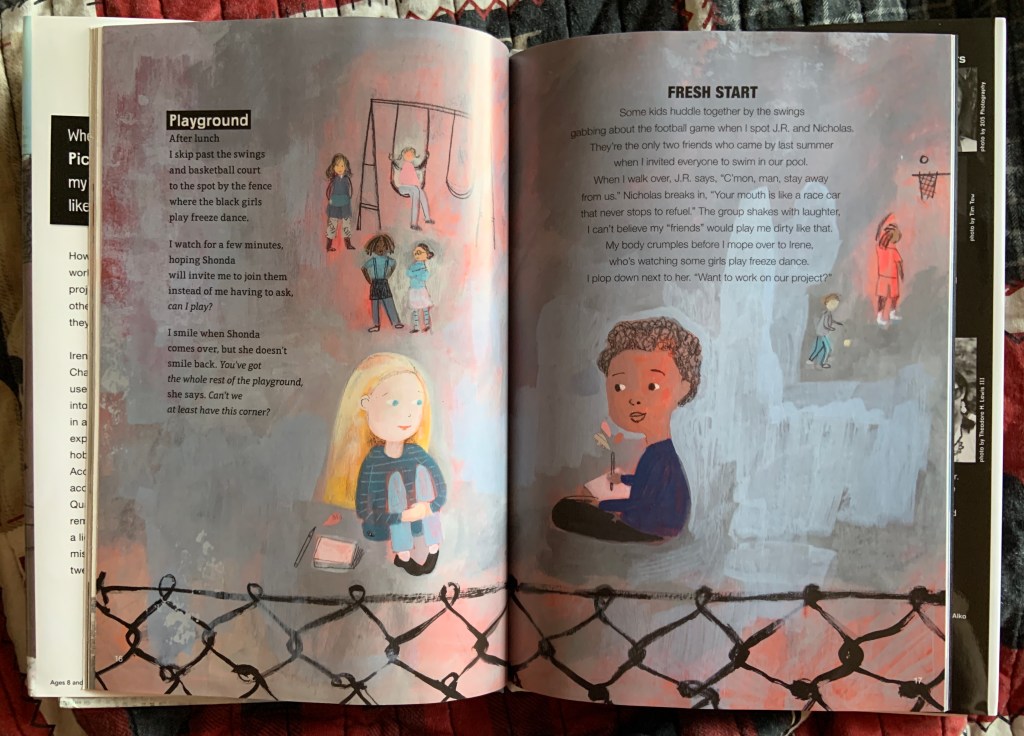
Can I Touch Your Hair? is written in poems and each poem brings a lot of meaning. The poems in the book are written from two different perspectives, a white girl and an African-American boy who are in the same class together and have to be one another’s partner. Throughout the book, the reader is being brought into each of the character’s worlds and how each one sees the world as the same or different for each topic discussed in the book. Their friendship also develops from not knowing/wanting to know one another to not being able to stop talking to each other in class. Can I Touch Your Hair? tells how poetry and sharing stories can bring others closer and create a meaningful friendship. At the end of the book, the two characters want to be partners for every project. This book demonstrates how even though two people may be two different races and have completely different experiences in life, they can still be friends and understand one another.
The authors did an amazing job creating these poems and how well the poems demonstrated two completely different lifestyles. There were also many issues that are still being faced in the world today that are in incorporated into the poems like race and stereotypes. The illustrators also did a fantastic job creating the illustrations in the book. One of my favorite is when the girl and the boy are talking to one another in class on page 35 and the illustrators chose to have flowers bloom from their mouths. The poem is also called “Blooming Flowers” and the illustration represents the title well.
This book is based off of the authors relationship. The authors are Irene Latham and Charles Waters. In fifth grade these two became acquainted with one another through Poetry Fridays their school did online, Irene lived in Louisiana and Charles lived in Pennsylvania. Each poem is based on their lives and experiences and now the two are life-long friends. There are also two illustrators, Sean Qualls and Selina Alko. They are married to one another and live in Brooklyn, NY with their two children. Both have illustrated many books and Qualls has won a Coretta Scott King Illustrator Honor for Before John Was a Jazz Giant.
Can I Touch Your Hair? can be used as a counter narrative which means it uses authentic voices that critique cultural assumptions. Irene and Charles both have voices that can break apart the cultural assumptions given to them. A few are, Irene wanted an afro when she was younger and was laughed at; Charles is not the greatest at basketball, but loves to read; Irene wants to play with the black girls on the playground, but they don’t want her to; and when Charles got help from the police officer when he got stuck on the chain-link-fence. All of these are examples of breaking stereotypes. Some people think that because someone is white they should not have an afro, because someone is black they should not be good at doing schoolwork, because people are two races they should not play together, because someone is black hopping over a fence they are up to no good. This book breaks those stereotypes to demonstrate just because someone is a certain race, does not mean they should not be able to do something someone else is doing.
Author and Illustrator Websites
Irene Latham: https://www.irenelatham.com/
Charles Waters: https://www.charleswaterspoetry.com/
Sean Qualls: https://www.seanqualls.com/
Selina Alko: https://www.selinaalko.com/
Teacher Application
These two books would be great to introduce the topics of race, social justice, overcoming, and breaking down stereotypes. Students need to be made aware of the issues that are going on around them and how it affects many people. They also need to see that these issues are still happening today and to gain better understanding of what they could do to help end these issues. Some discussion questions that can be used to help guide the students to think more about a topic. These are from Tara Yosso (2005) in the Marshall article (2016).
How does the subject of this auto/biography maintain hopes and dreams in the face of barriers?
How do the illustrator and/or author communicate their story in images and words?
Does the author include or write in more than one language or dialect? Are certain literary forms used in the book, such as parables or poems?
What knowledge or lessons do young people in these auto/biographies use that come from their families and/or communities?
What documents, photos, or information do the author and/or illustrator include in their life writing? Why?
Upon what networks of people in the community do the author and/or illustrator rely?
How do youth navigate through institutions like the school that are not set up for communities of color and/or Indigenous peoples?
In what ways (e.g., challenging adults, participating in protests, testifying in court) do youth resist unfair treatment or discrimination?

 Mrs. Thompson's Blog