Each of these stories focuses on a person or a crayon that is different from others. The stories give us insight into another life and how theirs is different or similar to ours. These books remind me of the metaphors of a mirror, a window, and a sliding glass door. A mirror is a story that reflects your own life and you see yourself. A window is when you get the opportunity to look into someone else’s life. A sliding glass door is when you get the chance to step into a whole new world and experience a life completely different than your own.
Red: A Crayon’s Story
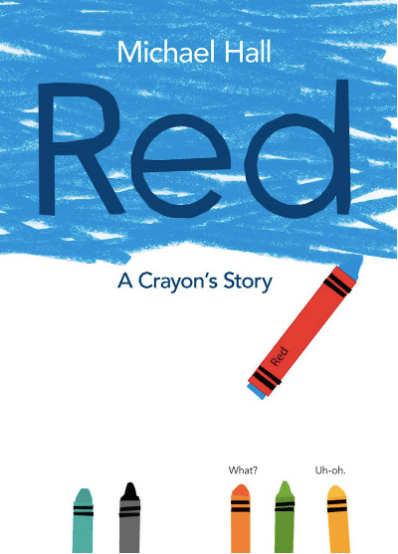
Red: A Crayon’s Story demonstrates how society usually assumes who we are based on what we look like on the outside or trying to conform us into something we are not. This book focuses on a crayon that is labeled red and expected to draw in the color red, but is actually a blue crayon. I feel like this applies to numerous people and students in classrooms now. This book also makes the setting a classroom which makes things feel even more realistic.
There were many themes that were in this book which are labeling, finding ones self, and finding acceptance. Throughout this whole book, the blue crayon had the label of being red and was expected by his teacher, mother, grandparents, and peers to draw in the color red. When he did not do this, he was given ideas of how to better become red. He was partnered with others crayons, was told to draw pictures of things that are red (strawberries, cherries, hearts), and other tools tried to help him (tape him together, sharpen him, cut a snip in his label for it being too tight). Until eventually a different crayon asked him to draw an ocean. When he colored the ocean, his friend, Berry, had him realize he is blue. Once he found he was blue, he continued to color all things blue and everyone started to talk and calling him brilliant or saying he is reaching for the sky. This also relates to how he found his true self and his true color. So many times, students get labeled and are seen as that and are expected to do nothing more or nothing less than that. Being able to find who someone truly is can uncover a lot more talent than others think they have. He also finally found acceptance. For a long time, everyone was telling him he was different and not doing what he was supposed to do. Once he found who he was, he was finally accepted by others and accepted who he was too and was proud of it.
I think it is very interesting how this story took place within a classroom because it is a very true experience for many students within a classroom. They get labels like they are a bad students, not smart enough, need extra support, the list could go on and on. This labels can carry on throughout the school year without given the chance to break those labels. As teachers, we have to remember that a student should not be given a label because they should be given the opportunity to break those labels that have been given to them and not feel constricted to one thing.
Rescue & Jessica: A Life-Changing Friendship
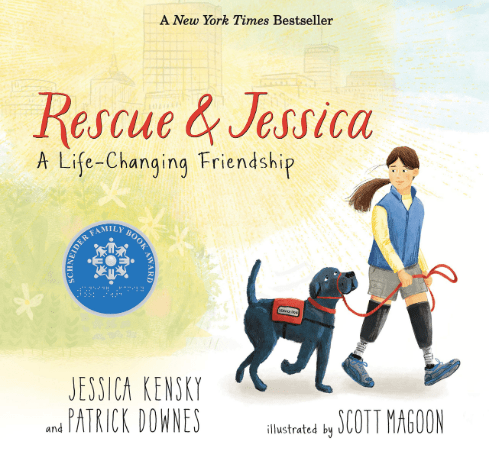
Rescue & Jessica: A Life-Changing Friendship is based on a true story where a girl, Jessica, who becomes a double amputee due to the Boston Marathon bombing and has to learn how to do life with extra support from a service dog, Rescue. In the book, they both realize they both needed each other. They learned how to do everything together and how to rely on one another. I have always known how important it is to have service dogs, but this book made me realize even more why service dogs are so special.
The themes that were shown in this book are physical disability, caring for one another, and taking on new responsibilities. Physical disability played a huge role in this book and is something that is not portrayed in a lot of children’s book. Jessica had to learn how to live her life with this new physical disability that she thought she would never have to face. When she met a service dog in the beginning, she realized how much she needed one herself. She was given Rescue as her service dog and they relied heavily onto one another. Each had to care for one another. Rescue had to help Jessica when she needed something or was trying to accomplish something that she couldn’t. Rescue also comforted Jessica when she was felling down or discouraged. Jessica had to take care of Rescue such as feeding him, playing with him, and comforting him. This also relates to the theme of taking on new responsibilities. Both Rescue and Jessica were expected to have to take on new responsibilities like Rescue taking care of Jessica and Jessica being able to perform and work towards using her new legs.
This book reminds me a lot of an #OwnVoices book. Both authors were challenged with this new perspective and lifestyle. Both became amputees due to the Boston Marathon bombing. This book was very personal for both and they both poured their thoughts and emotions into this book. Although, Jessica (in real life) was an adult when she became a double amputee, her story and emotions are the same. This book let them voice their life and show it in a way for everyone to understand. Jessica, Patrick, and Rescue’s story was demonstrated very well in this book.
This link provides more information about Rescue and Jessica and an interview with Jessica and Patrick about how Rescue has helped tremendously. https://www.wbur.org/artery/2018/04/11/rescue-and-jessica
Last Stop on Market Street
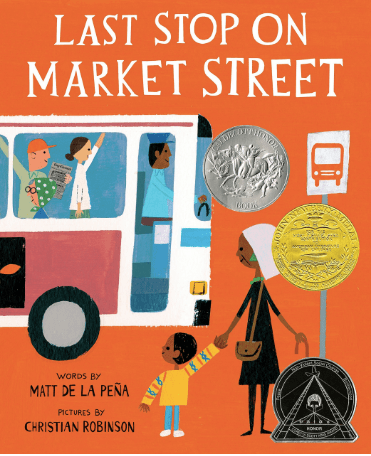
Last Stop on Market Street is about a boy, CJ, who views his life differently than those he is around most often. In this book, we meet CJ and his grandmother, Nana. Throughout, he asks questions to his grandmother like why do they have to ride the bus, why doesn’t he have a device to listen to music on, and why they have to go to go to a certain place after church. To him, it didn’t make sense that he had to do these things, but other students at his school or people he saw out and about could go home in a car or could listen to music on devices. As their journey continues, they end up at a soup kitchen to serve meals to others. This book demonstrates how people can live their lives so differently and gives real-life examples of what they could be.
The themes shared in this book are building community, finding beauty in unlikely places, and the value of helping others. Building community is found from the beginning to the end of this book. From the relationships that are made on the bus to the relationships that are made in the soup kitchen. Nana is teaching CJ the importance of community and showing him that having a community is essential. Throughout the book, CJ seems to find the bad in many situations or cannot see a brighter side to not living a certain way. However, Nana finds the good in everything. The first example shown is when they are waiting for the bus to come and CJ asks why they don’t have a car and his Nana replies why do they need a car when there is a bus who has Mr. Dennis as the bus driver who does magic tricks. Another is when he sees others who are listening to music on a device and says he wishes he had one. His Nana responded with why would you want one when you have live music right here. She was referring to a man who had a guitar on the bus and he began to play. To CJ, he didn’t think these little things could be so beautiful in the long run, but with Nana’s help, he saw the beauty. The last is the value of helping others. At the end of the book, we see CJ and Nana in the soup kitchen serving others food. The picture that is shown is very impactful and shows a community coming together. CJ is learning at a young age the importance of helping others and how it makes him feel. When they arrive outside the soup kitchen, CJ tells Nana he is glad they came. Reading this makes the reader realize CJ is gradually understanding the value in helping others, but also seeing beauty in what is being done.
Connections Between Books
Each of these books represents a mirror, a window, or a sliding glass door for all readers. Each one represents a different lifestyle and how each plays an important role in society and the way people think about others. The books focus on one individual who experiences life differently than those around them. For Red, he was mislabeled, but others expected him to be red without thinking he could be something different. For Jessica, she was a double amputee and had to learn how to live her life with two new legs and with a service dog. For CJ, he did not understand why his life looked different than other people he knew or saw like riding the bus or going to the soup kitchen.
Each book dives deeper into understanding what/how other lifestyles can differ from one another and how everyone has a different perspective. Also, each book focuses on a child like Red, Jessica, and CJ which can be very impactful for other children who read these books because it is a book about someone that may be around their age or share an experience. The books also give the child a companion who helps them see life in better ways. Red met Berry later on who helped him recognize he was blue, Jessica was given Rescue to help with daily activities and to comfort her, and CJ had Nana who helped him see the beauty in the world and teach him the value of community. Each book demonstrates how different types of relationships are so meaningful to have.
Teaching Connections
There are so many ways to incorporate these books into the classroom. When I was growing up, books like these were not read to me often in the classroom. I think it is essential for students to be able to hear these stories and see how others live their lives and what kind of impact it has on them. I also think students could relate to the characters in the books and make connections to the characters. The students would also have the opportunity to discuss with their classmates how the books made them feel and we could talk about the importance of each one.
One of the strategies that stood out to me from the Chapter 2 Teaching Critical Literacy from Critical Literacy : Enhancing Students’ Comprehension of Text was the Connection Stems strategy. This strategy allows the students to make connections within the book and to their lives. When they have completed their Connection Stem, they get the opportunity to share with others and use text evidence and personal experiences to explain the connections. I also love the examples of the Connection Stems and how students can begin their explanations. Examples: “That reminds me of…” “I remember when…” “An experience I have had like that …” Having these discussions in class can help build upon our classroom community and be able to open up to one another.

 Mrs. Thompson's Blog